
Key Takeaways
- From history, the stock market experiences significant short-term uncertainty and volatility during war because investors react to changing expectations about interest rates, economic growth, inflation, and their earnings.
- Selling your investments because of fear can make it difficult to participate in a potential market recovery.
- It’s best to have an investment strategy that not only takes into account your financial goals but can also tolerate market fluctuations.
- Long-term investing with the help of a Fero Financial planner can put the short-term effects of geopolitical events into perspective and guide investors to make informed decisions rather than react to news headlines.
Investing is already filled with uncertainty, but geopolitical conflict can add another layer of complexity. News of wars, sanctions, and rising political tensions can influence how investors feel about the market. But beyond the headlines, how does war really affect the stock market, and what might it mean for your portfolio?
We know that markets tend to react sharply to unexpected events, and war can trigger significant short-term reactions. However, history shows that those swings don’t necessarily translate into poor long-term investment outcomes.
So, does that mean investors can use historical stock performance during periods of geopolitical risk when making investment decisions?
Let’s explore this further.
How Does the Stock Market Behave During War?
The stock market’s initial reaction isn’t always easy to predict because it depends on the type and severity of conflict, the expected business and economic impact, and whether the news caught investors off guard.
When war breaks out, or geopolitical tensions rise, investors may become more cautious about where they put their money. The uncertainty can cause market volatility, as prices swing more sharply as investors reassess what the latest developments could mean. Some sectors may be more exposed than others, such as those that rely heavily on fuel, global trade, transportation, or overseas suppliers.
However, it’s worth noting that during periods of conflict, markets can also be influenced by government spending, inflation, central bank decisions, and commodity price changes driven by supply disruptions.
With all these factors at play, we can’t reliably conclude that markets react predictably to every conflict. Simply, there’s no one-size-fits-all market reaction when it comes to stock market behavior during war.
A Closer Look at the Historical Performance of the Stock Market
While we cannot predict what’s to come, we can look at history to understand how war affects the stock market.
The S&P 500 has operated through many wars and geopolitical conflicts. Since the late 1920s, the index has experienced market reactions around major conflicts or volatility, but these have also occurred alongside longer stretches of market growth.
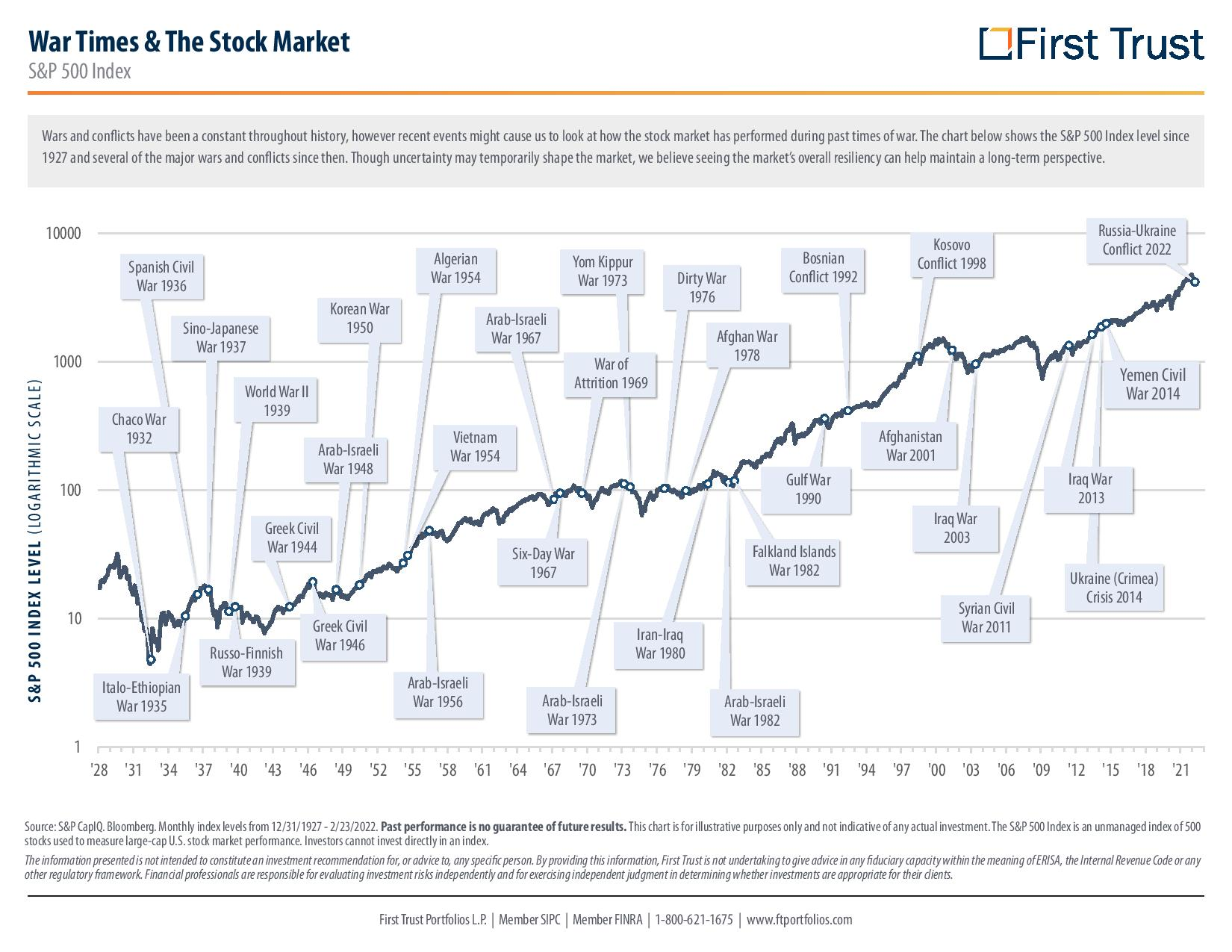
While this historical perspective does not raise concerns regarding geopolitical risk and investment, it’s not a reason to overlook conflicts. Rather, it’s proof that a single event or a challenging period does not entirely determine how an investment portfolio will perform over time.
Hence, for long-term investing, constantly keeping your eye on the latest headlines can make it harder to stay focused on your financial plan.
Keep a Long-Term Perspective
We’ve established that past events can only offer useful context, but they cannot predict exactly how the stock market will move during the next war or conflict. History only provides perspective because each conflict unfolds differently, and that can lead to very different market reactions each time.
Over the years, the stock market has weathered wars, political turmoil, inflation, recessions, and many other forms of uncertainty. You can expect immediate short-term declines when these events happen, but these dips do not necessarily call for a change in the broader goals of your well-constructed long-term financial plan.
So, rather than trying to predict market rises and falls and their potential effects, long-term investors should focus on keeping their investment strategy aligned with their broader financial objectives. By extension, let your investment strategy be aligned with your overall financial plan rather than by the latest headlines.
Plan for Uncertainty With Fero Financial
While you can’t predict geopolitical conflicts or how the stock market will react during war, you can, however, prepare your financial plan for periods of uncertainty.
Fero Financial helps clients prepare for unforeseen events by considering the bigger financial picture and aligning their financial decisions with personal priorities, retirement goals, and evolving life circumstances such as widowhood, caregiving, and estate planning.
Rather than recommending a one-size-fits-all financial strategy, we guide you to review your portfolio and financial plan through the lens of who you are, your unique circumstances, and where you want to go.
If market volatility and current world events have you wondering how war would affect the stock market and your investment strategy, contact Fero Financial to schedule a conversation with a financial planner. A thoughtful review of your current plan, or an entirely new one, can help you stay focused on your long-term goals, even when the headlines are full of uncertainty. Call Fero Financial today.
FAQs
Does the stock market always fall during war?
No, the stock market performance depends on the circumstances surrounding the conflict. Some sectors may decline, while others may respond differently as investors assess the economic impact of the conflict.
Can war affect retirement investments?
Yes, war-related market swings can affect retirement portfolios, especially for people nearing retirement or already relying on their investments for income. The amount of impact largely depends on your portfolio mix, how much you need to withdraw, and your overall financial strategy.
Can diversification help during wartime stock market volatility?
Yes, diversification spreads investments across different industries, classes, and even geographical areas to minimize risk. Although investment risks are not completely eliminated, diversification reduces your reliance on a single investment tool or market.
Why is long-term investing important during market uncertainty?
Long-term investing is important because it emphasizes working on your financial goals over time, rather than trying to predict every short-term market swing. In this way, investors keep the bigger picture in mind when temporary market volatility raises concern.